Cut-resistant yarn is not a single material. It is an engineered yarn system in which high-strength fibers, reinforcing filaments and supporting yarns are arranged to deliver a useful balance of strength, flexibility, smoothness and knitting performance.
For anyone sourcing cut-resistant glove yarn, the fiber name is only the starting point. UHMWPE, aramid, glass fiber or metal wire may supply different properties, while the yarn structure determines how those components work together. This guide focuses on the three foundations of cut-resistant yarn: the fibers themselves, core-spun yarn and covered yarn.
1. Fibers used in cut-resistant yarn
A fiber can contribute strength, hardness, heat resistance, flexibility or surface comfort. Most practical glove yarns combine several of these functions because no single fiber provides every desired property.
UHMWPE and HPPE yarn
Ultra-high-molecular-weight polyethylene (UHMWPE) is a lightweight, high-strength polyethylene fiber. In the protective-glove market, yarn systems based on this fiber are often described as HPPE, meaning high-performance polyethylene.
UHMWPE is valued for its favorable strength-to-weight ratio, energy absorption, flexibility and resistance to many corrosive environments. These qualities make it useful in thin, flexible glove-liner yarns. Common filament sizes in yarn construction include 100D, 200D and 400D, although the final specification depends on the intended yarn and knitting design.
HPPE should not automatically be understood as a pure, single-component yarn. A commercial HPPE glove yarn may combine UHMWPE with nylon, polyester, spandex, glass fiber or metal reinforcement. The complete recipe and construction influence the feel and behavior of the yarn.
Aramid fibers
Aramid fibers are aromatic polyamides known for high strength and heat-resistant properties. Two types appear in technical textile applications:
- Meta-aramid (aramid 1313) is mainly valued for heat and flame resistance, electrical insulation and dimensional stability at elevated temperatures.
- Para-aramid (aramid 1414) provides high tensile strength together with useful cut, abrasion and heat resistance. It is widely used in protective yarns, gloves and sleeves.
Para-aramid may be used as filament or staple fiber. In cut-resistant yarn, it can form the main yarn body or cover a reinforcing core such as glass fiber or fine steel wire. Surface feel, exposure to light and moisture, and the behavior of the complete blend should all be considered when designing the yarn.
Glass fiber
Glass fiber is an inorganic reinforcement made primarily from silica-based materials. It offers high hardness, good heat resistance, chemical stability and electrical-insulation properties. In a composite cut-resistant yarn, glass can reinforce the structure without adding the weight associated with some metal components.
Glass fiber is comparatively brittle and does not tolerate repeated bending as well as softer textile fibers. It is therefore normally enclosed or covered rather than exposed at the yarn surface. Good coverage helps protect the filament during knitting and improves the feel of the resulting liner.
Basalt fiber
Basalt fiber is produced by melting natural basalt rock and drawing it into continuous filaments. It combines heat resistance, chemical stability and useful mechanical properties. Fine basalt filament can be incorporated into yarns intended for cut- and heat-resistant textile constructions.
Compared with conventional textile fibers, basalt can have lower abrasion tolerance and may be more difficult to process consistently. Yarn design must therefore manage filament breakage, surface coverage and production stability.
Steel and tungsten wire
Fine steel wire can be used as an internal reinforcing element. Its hardness can strengthen a yarn against sharp edges and can also contribute to puncture and abrasion resistance. In the supplied training examples, fine wire diameters range from approximately 0.03 to 0.055 mm.
More metal is not automatically better. Wire diameter, flexibility and position within the yarn affect stiffness, weight and wearer comfort. The surrounding textile layers need to stabilize the wire and prevent it from dominating the surface feel.
Tungsten wire provides high strength and heat resistance at very small diameters, but it is difficult and costly to process and can be hard or brittle. It is therefore used selectively in engineered yarn constructions rather than as a general-purpose component.
High-strength nylon and polyester
High-strength nylon combines low weight, abrasion resistance, flexibility and good processing behavior. It may serve as a supporting yarn, an outer covering or part of a composite glove-liner yarn. High-strength polyester offers dimensional stability, abrasion resistance and chemical durability, and can likewise be used to improve yarn stability and knitting performance.
Spandex may also be introduced when elasticity and liner fit are important. These supporting fibers may not be the primary cut-resistant element, but they help turn hard or high-strength components into a yarn that can be handled and knitted consistently.
2. How core-spun yarn is constructed
Before looking at the structure, it helps to distinguish two basic textile forms. A filament is a long, continuous strand, while a staple fiber is a shorter length that must be spun into yarn. Core-spun yarn brings these two forms together.
A core-spun yarn places a filament or filament bundle at the center and wraps or spins staple fibers around it. The core supplies properties such as strength, hardness or elasticity; the outer staple layer supplies a textile surface with improved softness, moisture management, appearance or processing behavior.
Typical cut-resistant core-spun constructions include:
- para-aramid staple fiber spun around a fine steel-wire core;
- para-aramid fiber combined with a glass-filament core;
- cotton spun around glass fiber to combine a familiar textile surface with reinforcement;
- viscose spun around glass fiber to add softness and moisture absorption around a stronger inner element.
The quality of the coverage is crucial. If the core is off-center or insufficiently covered, the yarn may feel uneven, expose hard reinforcement or create problems during knitting. A stable, well-centered core allows the outside fiber to protect the inner filament while preserving its contribution to the yarn.
3. How covered yarn is constructed
A covered yarn starts with a central filament, staple yarn or elastic core. One or more outer yarns are then wound helically around it. Depending on the number of covering layers, the result may be described as single-covered, double-covered or triple-covered yarn.
- Single-covered yarn uses one outer yarn wound in one direction around the core.
- Double-covered yarn adds a second covering layer, often wound in the opposite direction to improve balance and coverage.
- Triple-covered yarn adds another layer when the recipe requires additional reinforcement, separation or surface control.
Covered yarn can provide an even, full and relatively smooth surface with fewer exposed filaments. By selecting the core, covering material, winding direction and degree of twist, a manufacturer can combine elasticity, strength, reinforcement and knitability in one yarn.
A common glove-yarn concept uses UHMWPE as the principal high-strength component, nylon or polyester as a stabilizing cover, and spandex for elasticity. Glass filament, steel wire or an additional plied yarn may be introduced inside the structure when more reinforcement is required. The hard component is kept away from the surface by the softer covering yarns.
Core-spun yarn vs. covered yarn
| Point of comparison | Core-spun yarn | Covered yarn |
|---|---|---|
| Basic structure | Staple fibers are spun around a central filament or bundle. | One or more continuous yarns are helically wound around a core. |
| Outer surface | Usually has the character of the selected staple fiber. | Usually reflects the selected covering filament or yarn. |
| Main design purpose | Combine the inner core’s properties with a textile-like outer layer. | Stabilize, protect and combine several continuous yarn components. |
| Typical reinforcement | Glass filament or fine steel wire inside aramid, cotton or viscose staple fiber. | UHMWPE, glass, steel, nylon, polyester and spandex arranged in layers. |
| Key process controls | Core position, staple coverage, yarn evenness and spinning quality. | Covering tension, winding direction, wrap density and layer balance. |
From yarn structure to glove liner
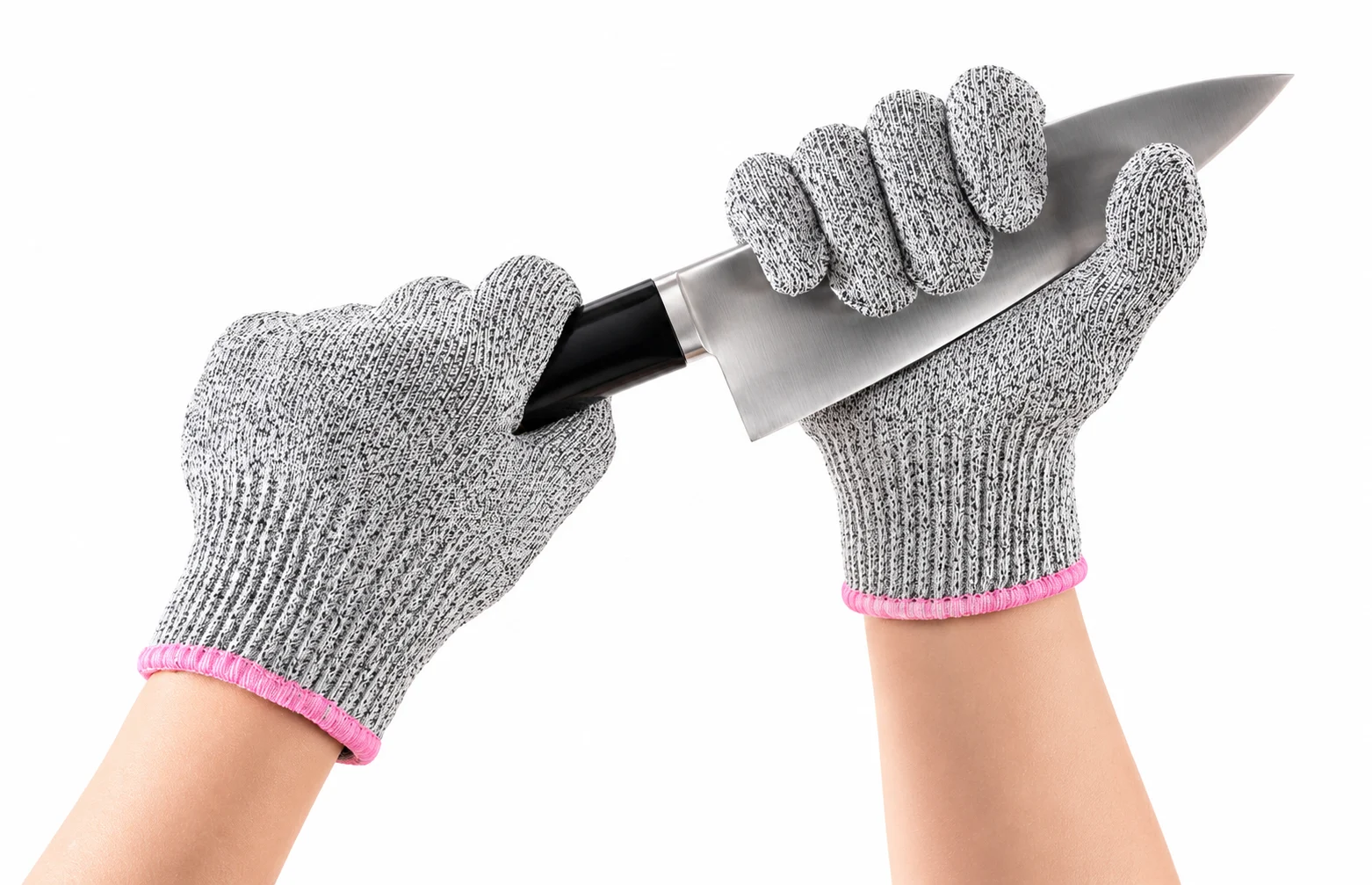
Cut-resistant yarn is commonly knitted into seamless glove liners. The liner’s gauge describes the density of the knitting needles, while the yarn recipe determines what can be knitted reliably at that gauge. A heavier aramid-and-wire yarn may suit a coarser liner, whereas a carefully covered UHMWPE composite can support a finer, smoother construction.
Two liners can contain similar fibers and still feel different. A yarn with more plied reinforcement, thicker glass filament, metal wire or higher twist may feel firmer. A construction with finer components, balanced covering layers and elastic support may feel softer and conform more closely to the hand.
For yarn identification and quality control, it is more useful to examine the construction than to rely on color or a broad material name. Carefully untwisting a sample can reveal the number of layers, the direction of the covering yarns and the presence of glass or metal reinforcement. Supplier specifications should describe the component materials, yarn count or denier, wire or filament size where applicable, and the covering arrangement.
Frequently asked questions about cut-resistant yarn
Are HPPE and UHMWPE the same?
UHMWPE is the underlying high-strength polyethylene fiber. HPPE is a broader commercial term often used for high-performance polyethylene yarn systems. An HPPE yarn may be a composite that includes UHMWPE together with nylon, polyester, spandex, glass or metal reinforcement.
What is the difference between core-spun and covered yarn?
Core-spun yarn is made by spinning staple fibers around a central core. Covered yarn is made by winding one or more yarns helically around a core. Both structures combine materials, but they use different production methods and create different surfaces.
Why are glass fiber or metal wire added?
Glass and metal are hard reinforcing elements. When placed inside a stable yarn structure, they can strengthen the composite against sharp edges. They need adequate outer coverage because exposed or poorly controlled reinforcement can reduce flexibility, processing stability and comfort.
Why can two yarns made from similar fibers feel different?
Yarn count, filament diameter, number of components, twist, covering direction, wrap density and reinforcement position all affect the finished feel. The fiber list alone does not describe the complete yarn.
Why is one glove liner stiffer than another?
A liner may feel firmer when its yarn uses thicker or more numerous reinforcing elements, plied yarns, metal wire or higher twist. A finer, more balanced covered yarn can produce a smoother and more flexible liner even when some of the component fibers are similar.
Discuss a cut-resistant yarn project with SafeLink
SafeLink works with protective-glove buyers and distributors on yarn composition, liner construction, coating options and OEM/ODM development. Share your preferred fiber system, liner gauge, hand feel and target application so we can organize a focused product discussion.
Explore SafeLink hand-protection products or contact SafeLink about a cut-resistant glove project.